SC-300 Exam Study Guide & Practice Questions, How I Just Renewed My Microsoft Identity and Access Administrator Certification
I have just renewed my SC-300 certification, and the experience reminded me exactly why this exam continues to be one of the most valuable Microsoft credentials anyone in IT can hold. If you are preparing to sit the SC-300 exam for the first time, or you are coming up to renewal like I was, this article is a deep, honest walkthrough of what the SC-300 actually tests, what surprised me on renewal day, and the full SC-300 study guide I built to help others get certified, and it’s free.
my complete SC-300 study guide and practice exam questions < – Click
Never miss an article and subscribe, and don’t forget to check out my YouTube channel, Control Alt Delete Tech Bits
Like the article? Feel free to buy me a coffee
Also check out my redact app, Redact PDFs and images, review email evidence and manage subject access requests without sending source files to a processing server.: https://redactninja.com
Why I Renewed My SC-300 Instead of Letting It Lapse
When my renewal window opened, I will be honest, I considered letting the SC-300 expire. I already hold several other Microsoft certifications, and there is always the temptation to chase the next shiny badge instead of maintaining what you have. But within about ten minutes of looking at the renewal assessment objectives, I realised how much had shifted since I first sat the SC-300 exam. Microsoft Entra ID has moved on significantly, authentication strengths, cross-tenant access settings, the new Conditional Access templates, and a noticeably tighter focus on identity governance and Privileged Identity Management.
The renewal itself is free, takes place on Microsoft Learn rather than in a Pearson VUE test centre, and is unlocked six months before your certification expires. The questions are shorter and more focused than the full SC-300 exam, but they are not easier they specifically target the areas Microsoft has updated since you originally certified. That alone is reason enough to renew rather than re-sit. If you have a current SC-300, please do not let it slip; if you are studying for the first time, know that the certification keeps paying off year after year because Microsoft Learn keeps the renewal route free and online.
What is the SC-300?
The SC-300 exam is officially titled Microsoft Identity and Access Administrator, and passing it earns you the Microsoft Certified: Identity and Access Administrator Associate badge. It is one of the four associate-level security certifications that feed into the Microsoft Cybersecurity Architect Expert (SC-100) credential, and in my view it is the most practically useful of the four. Identity is the new perimeter, and the SC-300 tests whether you can actually configure, secure and govern that perimeter inside Microsoft Entra ID, not just describe it in theory.
The exam consists of between forty and sixty questions, you have one hundred minutes to complete it, and the passing score is seven hundred out of a thousand. The format mixes traditional multiple choice with drag-and-drop ordering, hot-area diagrams, build-list questions, and at least one extended case study that usually accounts for around fifteen percent of your total mark. The case study is where most candidates lose time, you cannot go back to it once you submit, so you need to read every tab carefully before answering. Expect to pay around £165 in the UK when you book through Pearson VUE, and the certification remains valid for one year, renewable free of charge thereafter.
The Four Skill Areas
Microsoft breaks the SC-300 down into four domains, but the official skills outline can read like a shopping list. What actually matters is how those domains show up in the questions, so let me walk through each one the way you will encounter it on exam day.
Identity Management, Roughly a Quarter of the Exam
This domain covers tenant configuration, user and group lifecycle, external identities, and hybrid identity with Microsoft Entra Connect or Cloud Sync. On the surface it feels like the easiest section because everyone who has touched Entra has created a user or a group. The trap is that the SC-300 exam rarely asks you to create anything; it asks you to choose the correct method given a specific business constraint. A typical question describes a multinational organisation with regulatory data-residency rules and asks whether you should use a single tenant with cross-tenant access settings, a multi-tenant architecture, or B2B collaboration with entitlement management. There is one right answer and it depends on subtle wording in the scenario. When I was studying for renewal, I deliberately practised reading scenarios twice before looking at the answers, because Microsoft writes them to reward careful reading rather than speed.
The hybrid identity sub-topic deserves special attention. Microsoft Entra Connect is being gradually replaced by Cloud Sync for most new deployments, and the SC-300 reflects that shift. Know the differences in supported topologies, filtering options, and password synchronisation behaviour. Know specifically when pass-through authentication is preferred over password hash synchronisation, and what happens when an on-premises account is disabled while the cloud account remains active.
This site and my YouTube channel are supported by Tech-Source.
Tech-Source is a UK-based technology supplier that works closely with IT teams across education, public sector, and commercial environments. They provide hardware, licensing, and infrastructure solutions, with a strong focus on practical advice rather than upselling.
Their support helps keep this site running and allows me to continue publishing in-depth, admin-focused content and walkthroughs without paywalls.
You can find out more about what they do at https://tech-source.co.uk/
Authentication and Access Management The Biggest Domain
This is the heart of the SC-300 exam and the area Microsoft has updated the most aggressively since I first certified. Multifactor authentication, Conditional Access, authentication strengths, Identity Protection, passwordless sign-in with FIDO2 and Windows Hello for Business, and the entire risk-based access story all live here. If you only have time to study one domain in depth, make it this one.
Conditional Access is where people lose marks. The exam will give you several policies and ask you to predict the outcome for a user in a specific state, perhaps a guest user signing in from an unmanaged device after a risky sign-in event. You have to mentally apply every policy in scope, remember that grant controls combine with AND logic by default while session controls layer on top, and recall that report-only policies do not actually block anything but do log what would have happened. The new authentication strengths feature is heavily tested in the current SC-300; you need to know which authentication methods satisfy the built-in MFA strength, the passwordless strength, and the phishing-resistant strength, and how to assign those strengths to specific resources through Conditional Access.
Identity Protection sits alongside Conditional Access, and the two are deliberately confused on the exam. Identity Protection generates the risk signals; Conditional Access acts on them. A question that asks how to automatically force a password reset when sign-in risk is high is testing whether you know how to configure a Conditional Access policy that targets high sign-in risk and grants access only after a secure password change. People answer “Identity Protection policy” out of habit and lose the mark because the standalone Identity Protection policies are now in the process of being deprecated in favour of the Conditional Access integration.
Workload Identities and Application Access
This domain tests your understanding of how applications authenticate and obtain consent within Microsoft Entra ID. The single most important concept here is the two-object model: every application is represented by an Application object (the global definition) and one or more Service Principal objects (the local instance in each tenant). Almost every workload identity question on the SC-300 exam hinges on understanding this distinction. If you grant a permission to an application, you are usually modifying the Service Principal in your tenant, not the Application object owned by the publisher.
The SC-300 also wants you to be fluent in choosing the right single sign-on protocol, SAML 2.0 for older enterprise apps, OpenID Connect for modern web and mobile apps, OAuth 2.0 for delegated and application-level API access, and password-based SSO as the legacy fallback. Be ready for scenario questions about admin consent workflow, user consent settings, and the difference between delegated and application permissions. Managed identities for Azure resources also live in this domain. Know when to use a system-assigned managed identity versus a user-assigned one, and remember that managed identities cannot be used outside Azure resources.
Identity Governance, The Domain That Has Grown the Most
Entitlement management, access reviews and Privileged Identity Management form the identity governance domain, and it has expanded considerably since the exam first launched. When I renewed, this was the area where I noticed the biggest shift in question depth. Access packages now appear in case studies with multiple catalogues, internal and external requestors, and approval workflows that span several stages. You need to be comfortable explaining when an access package expires, what happens to assigned resources at expiry, and how access reviews integrate with package lifecycle.
Privileged Identity Management is non-negotiable knowledge for the SC-300 exam. Eligible versus active role assignments, just-in-time activation, MFA on activation, approval requirements, maximum activation duration, and the difference between PIM for Microsoft Entra roles and PIM for Azure resources are all heavily tested. A common question describes a scenario where a Global Administrator activates a role and asks how to enforce MFA at activation time, even though the user has already signed in with MFA earlier in the day. The answer is to configure the role setting in PIM to require Microsoft Entra MFA on activation, not to add yet another Conditional Access policy.
How to Study for the SC-300
My approach to both the original exam and the renewal followed the same pattern, and I recommend it to anyone serious about passing first time. I used :
Course SC-300T00-A: Microsoft Identity and Access Administrator – Training | Microsoft Learn
Practice Assessments for Microsoft Certifications | Microsoft Learn
Online Hosted Instructions | SC-300-Identity-and-Access-Administrator
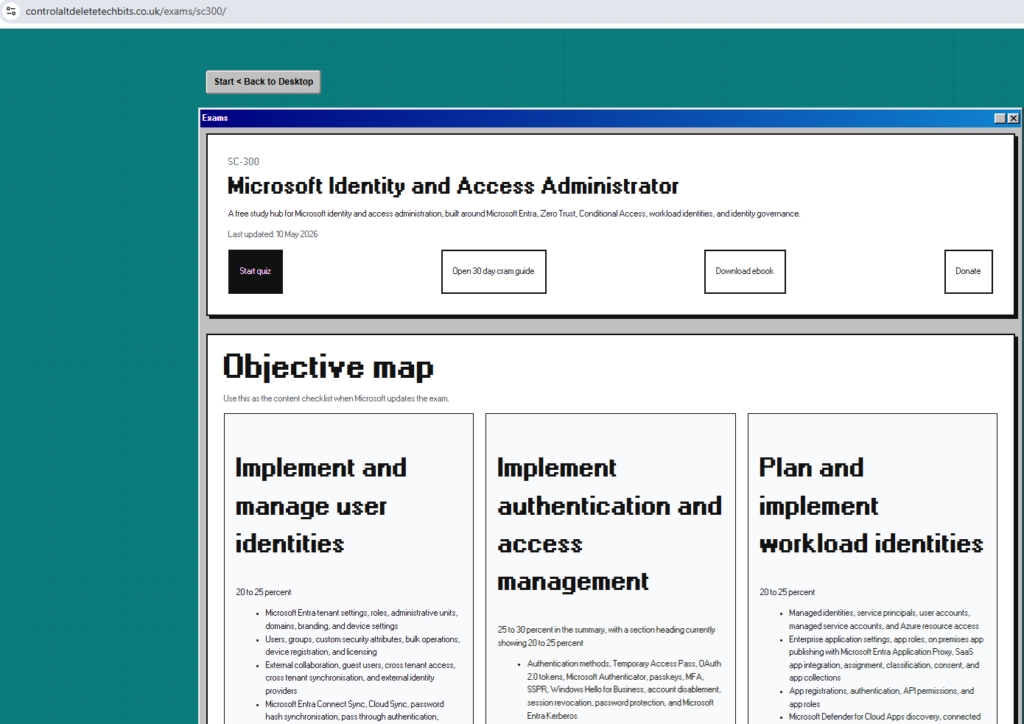
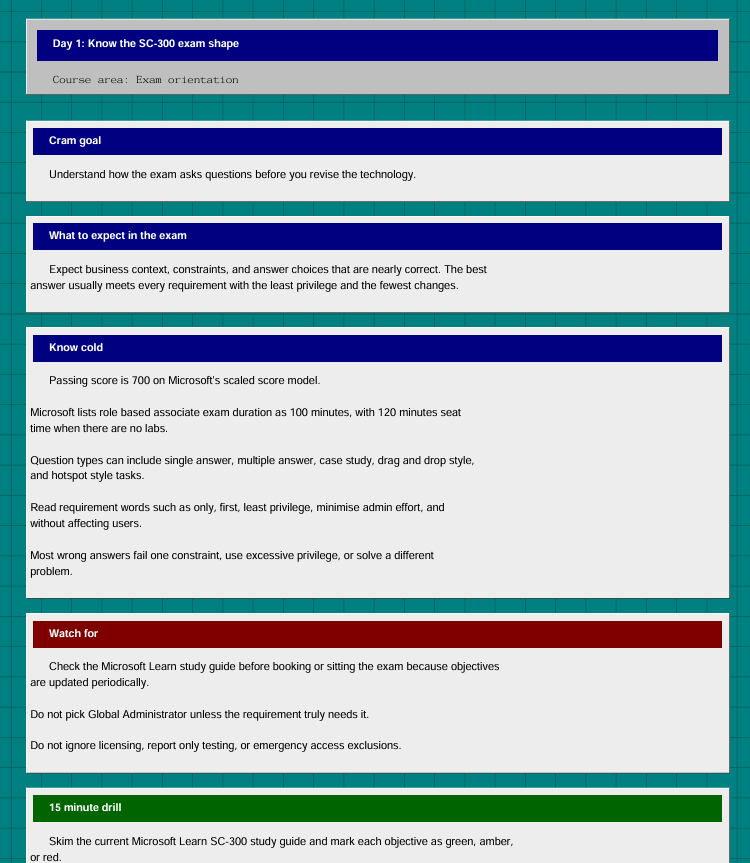
I then used my Dev tenant and created SC-300 study guide on this site. Below is a screenshot from SC 300 Microsoft Identity and Access Administrator 30-day study gram guide
Then move into hands-on practice in a free Microsoft 365 developer tenant. Microsoft gives you a fully featured Entra ID environment for free if you sign up for the developer programme, and you can practise everything the exam tests, configuring Conditional Access, enrolling FIDO2 keys, setting up PIM, creating access packages, running access reviews and integrating sample SaaS applications. The muscle memory you build from clicking through the admin centre is the single biggest predictor of passing the SC-300 exam on the first attempt. I cannot stress this strongly enough; theoretical study alone will not get you there.
Once you have done a hands-on lab for each domain, switch to the SC-300 practice exam questions. Drill them in batches of twenty, review every wrong answer in detail, and write down the underlying concept you missed in your own words. When you can score above eighty-five percent on a full-length practice exam two days in a row, you are ready to book the real thing. I gave myself two weeks of evenings for the renewal; for a first-time sitter without daily Entra ID experience, plan six to eight weeks at a similar pace.
Here is the link to everything SC 300
What is the SC-300 exam?
The SC-300 exam is the Microsoft Identity and Access Administrator exam. It tests whether you can design, configure, manage and troubleshoot identity and access solutions using Microsoft Entra ID. Passing the exam earns you the Microsoft Certified: Identity and Access Administrator Associate certification.
How hard is the SC-300 exam?
SC-300 is not a beginner exam, but it is manageable if you already have Microsoft 365 or Entra ID experience. The difficulty comes from scenario-based questions. Microsoft rarely asks simple “where do you click” questions. It is more likely to describe a business requirement and ask you to choose the most secure or least disruptive configuration.
How long should I study for SC-300?
If you already work with Microsoft Entra ID, Conditional Access and Microsoft 365 administration, two to four weeks of focused study may be enough. If you are newer to identity and access management, give yourself six to eight weeks. The key is not just reading Microsoft Learn. You need hands-on practice in a tenant.
Do I need hands-on experience to pass SC-300?
Yes, hands-on experience makes a big difference. You should practise creating users and groups, configuring Conditional Access policies, testing authentication methods, managing enterprise applications, setting up app registrations, using PIM, creating access reviews and reviewing sign-in logs. SC-300 rewards people who understand how the features behave in a real tenant.
What is the passing score for SC-300?
The passing score for SC-300 is 700 out of 1000. That does not mean you need exactly 70 percent, because Microsoft uses scaled scoring. Focus on understanding the objectives rather than trying to calculate a raw percentage.
How long is the SC-300 exam?
The SC-300 exam gives you 100 minutes to answer the questions. You may see different question types, including multiple choice, drag and drop, build list and case study style questions. Use the Microsoft exam sandbox before exam day so the format does not slow you down.
Is Microsoft Learn enough for SC-300?
Microsoft Learn is the best starting point for SC-300, but it should not be your only resource. Use it with the official study guide, hands-on labs, the Microsoft practice assessment, exam sandbox and your own revision notes. SC-300 tests how features work together, not just what each feature is called.
Tags: Entra ID, Intune, Microsoft Entra